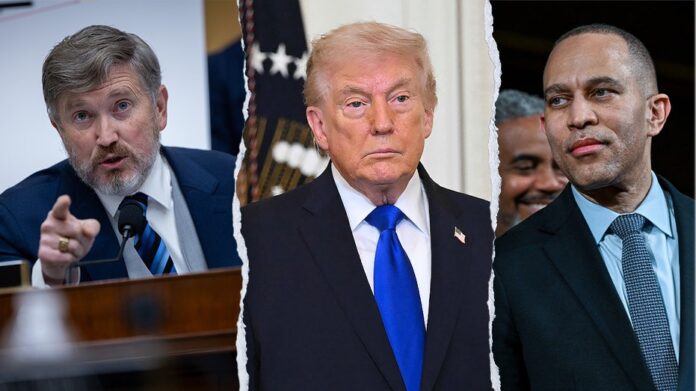


House Democrats join GOP Rep. Thomas Massie to force a vote on a war powers resolution aimed at curbing President Trump's military authority regarding Iran.
February 26, 2026
Introduction
In a significant legislative move, Representatives Thomas Massie of Kentucky and Ro Khanna of California have joined forces to advance a resolution aimed at restricting presidential war authority concerning Iran. This bipartisan effort is receiving notable support from leading Democrats, indicating a substantial political push to redefine the boundaries of executive military actions.
Democratic Endorsement
House Minority Leader Hakeem Jeffries, along with other prominent Democrats, has expressed unequivocal support for the resolution. In a recent announcement, Jeffries confirmed that the House would soon vote on this crucial measure. The joint statement by Democratic leaders underscores the necessity for the President to seek congressional approval before engaging in military actions against Iran, characterizing such actions without it as unconstitutional.
Constitutional Imperative
The crux of the Massie-Khanna resolution rests on the constitutional prerogative of Congress to declare war. As articulated by Massie, the Constitution mandates congressional approval for war, a principle he and Khanna are determined to uphold. This legislative effort emerges amidst rising tensions with Iran and follows incidents of civil unrest and government crackdowns in the region.
Political Dynamics
The proposed resolution leverages a legislative mechanism known as a “privileged resolution,” which compels a vote in the House within two legislative days of its introduction. This procedural strategy is particularly pertinent given the current narrow Republican majority in the House, making every vote critical. The resolution, while aiming for direct confrontation of presidential powers, must navigate potential procedural hurdles that could delay or prevent its passage.
Strategic Implications
The implications of this legislative action extend beyond immediate political maneuvering. Historically, U.S. involvement in Middle Eastern conflicts has been a contentious issue, with debates often focusing on the balance between national security interests and congressional oversight. The Massie-Khanna resolution, therefore, represents not just a challenge to President Trump’s policies but also a broader assertion of legislative authority over military engagements.
Conclusion
The outcome of this resolution could set a significant precedent for future executive-congressional relations concerning military interventions. As the House prepares to deliberate, the resolution’s progress will be closely watched, potentially influencing both domestic political strategies and international diplomatic stances. In this light, the Massie-Khanna initiative is not merely a legislative proposal but a pivotal moment in the ongoing dialogue about war powers and constitutional governance.
Originally reported by foxnews.com. Rewritten by 360DailyTrend editorial staff.