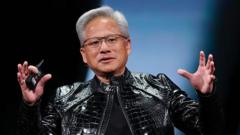


Demand for Nvidia chips rose even as the company sets out to create AI products of its own.
February 26, 2026
Nvidia, a leader in semiconductor technology, has achieved a landmark annual revenue of $215.9 billion, overcoming investor skepticism about substantial investments in artificial intelligence (AI) developments. This financial success is particularly noteworthy as it surpasses market predictions, fueled by a 73% surge in sales during the last quarter compared to the previous year.
### Surging Demand for AI Technology
The remarkable growth in Nvidia’s revenue reflects the burgeoning global demand for AI-related computing solutions. According to Jensen Huang, the company’s CEO, this demand is expanding at an unprecedented rate as industries across the board seek to leverage AI capabilities. Nvidia is at the forefront of this transformation, supplying critical hardware to prominent AI developers such as OpenAI and Meta. Huang emphasized that the investments in AI infrastructure are akin to building the factories that will drive the next industrial revolution.
Despite this progress, Nvidia faces challenges from investors concerned about the company’s extensive network of partnerships. Some critics have raised concerns over potential “circular financing” strategies that might obscure the true demand for AI technologies. Nevertheless, industry experts, like Gene Munster of Deepwater Asset Management, predict sustained growth in AI infrastructure development, highlighting the rapid adoption of AI tools and their impact on various sectors.
### Navigating Geopolitical Challenges
Nvidia’s global operations are also influenced by geopolitical tensions, particularly between the United States and China. Recently, the U.S. government granted conditional approval for Nvidia to sell its H200 chips to Chinese entities. This decision is part of a broader strategy to regulate technology transfer while maintaining competitive market positions. However, no sales have occurred under this agreement, indicating the complexities of international trade relations in the tech industry.
The company’s strategic moves extend beyond chip manufacturing. Nvidia is diversifying its product offerings, aiming to integrate AI into physical devices. At the recent CES technology event, Nvidia unveiled “Alpamayo,” an open-source AI platform designed to enhance autonomous vehicle technology. This innovation represents Nvidia’s commitment to expanding AI applications into new domains, including a planned robotaxi service set to launch next year.
### Expanding Market Footprint and Strategic Acquisitions
In addition to developing new technologies, Nvidia is strengthening its market position through strategic acquisitions. The recent purchase of Groq for $20 billion demonstrates Nvidia’s intent to enhance its capabilities in AI inference, the process of applying trained models to analyze real-world data. This acquisition is part of a broader effort to maintain a competitive edge as the AI landscape continues to evolve rapidly.
Nvidia’s achievements underscore its pivotal role in shaping the future of AI technology. As the company navigates economic and political challenges, its strategic investments and innovations position it as a central player in the ongoing digital transformation. The future promises further advances in AI integration across various industries, driven by Nvidia’s pioneering efforts.
Recommended For You
Affiliate disclosure: We may earn a commission from qualifying purchases.