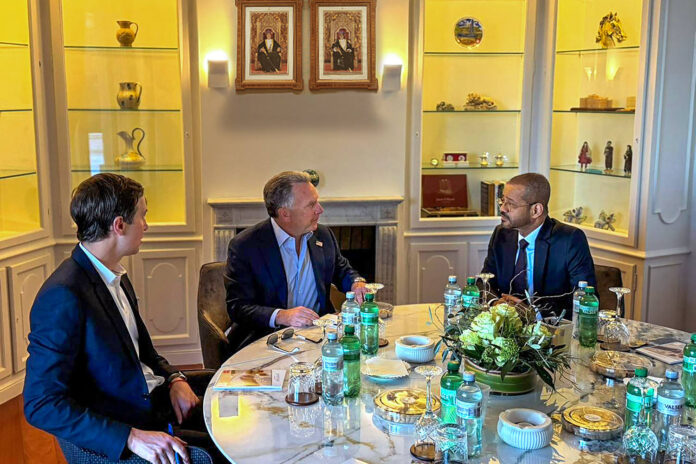


The United States and Iran met in Geneva on Thursday for high-stakes nuclear talks as President Donald Trump pressures Tehran with the threat of military action
February 26, 2026
Key Developments
The latest round of indirect talks between the United States and Iran, held in Geneva, marks a critical juncture in the ongoing effort to revive a nuclear agreement. Despite heightened tensions and previous military posturing, both sides have expressed optimism about the discussions. Iranian Foreign Minister Abbas Araghchi noted the achievement of “good progress” during the six-hour session, emphasizing a “serious review” of potential agreements on nuclear activities and sanctions. Meanwhile, U.S. sources described the talks as “positive,” suggesting a softened stance by the Trump administration amidst regional military escalations.
As these negotiations unfold, President Donald Trump has articulated heightened concerns over Iran’s missile capabilities and alleged nuclear ambitions. In his State of the Union address, Trump warned of Iran’s potential to develop missiles capable of reaching the United States, a claim Tehran vehemently denies. The talks, according to Omani Foreign Minister Badr al-Busaidi, acting as a regional mediator, concluded with “significant progress,” and are expected to resume shortly after consultations in respective capitals. Technical discussions are slated for Vienna, a hub for multilateral diplomacy on nuclear issues.
Analysis
The latest developments in U.S.-Iran relations must be viewed against a backdrop of longstanding geopolitical tensions and shifting alliances. Historically, Iran’s nuclear ambitions have been a flashpoint in U.S. foreign policy, exacerbated by the collapse of the Joint Comprehensive Plan of Action (JCPOA) following the U.S. withdrawal in 2018. This move, criticized by international observers, has led to increased uranium enrichment by Iran and a cycle of retaliatory actions.
The Trump administration’s current approach reflects a complex interplay of diplomatic pressure and military deterrence. While the Brookings Institution highlights the administration’s preference for maximum pressure, recent talks suggest a potential shift towards engagement, possibly driven by regional stability concerns and domestic political calculations ahead of impending elections.
What This Means
The outcome of these negotiations carries substantial implications for international security and regional power dynamics. Should the talks lead to a renewed agreement, it could stabilize the Middle East, reduce the threat of nuclear proliferation, and potentially ease U.S.-Iran tensions. However, if negotiations falter, the risk of military conflict escalates, particularly given the U.S. military buildup in the region.
Countries like Israel, which views Iran as a strategic threat, may find themselves at odds with diplomatic resolutions, favoring more aggressive containment strategies. Conversely, European allies, who have consistently supported diplomatic engagement, stand to gain from reduced tensions and restored trade relations with Iran.
The Bigger Picture
These negotiations are emblematic of broader geopolitical shifts in the Middle East. As the U.S. recalibrates its foreign policy focus, balancing traditional alliances with emerging regional powers, the nature of its engagement with Iran will play a pivotal role in shaping the future security architecture of the region. Moreover, the evolving discourse around nuclear non-proliferation highlights the need for robust international frameworks to prevent the spread of nuclear weapons, as emphasized by IAEA initiatives.
In conclusion, the U.S.-Iran talks are not merely about curbing nuclear ambitions but are a litmus test for diplomatic problem-solving in an era of complex global challenges. As these discussions progress, stakeholders must remain vigilant, balancing immediate security concerns with long-term strategic interests in an increasingly interconnected world.
Source: feeds.nbcnews.com